

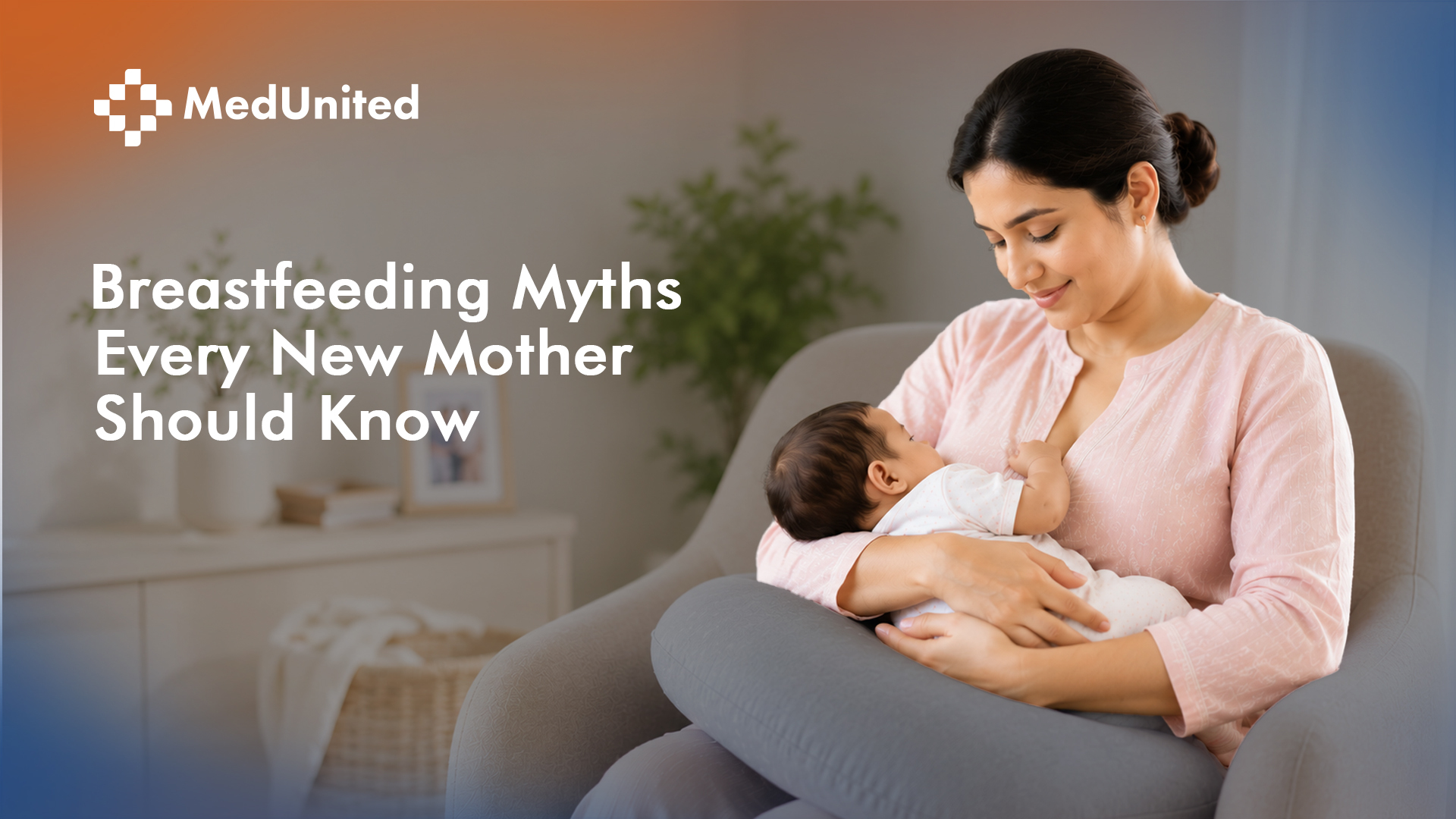
Breastfeeding Myths Every New Mother Should Know
By Dr. Polisetty Bala Prasunadevi
Consultant Obstetrician & Gynaecologist, MedUnited Hospitals, Palakollu
Breastfeeding is one of the most natural ways to nourish a baby, yet for many new mothers, it can also become a source of worry.
“Is my baby getting enough milk?”
“My milk looks thin-is it nutritious?”
“Should I give water along with breast milk?”
“My baby wants to feed again and again. Does that mean I don’t have enough milk?”
As a practising obstetrician and gynaecologist, these are some of the questions I hear from new mothers and families.
And I completely understand why.
After delivery, a mother is recovering physically and emotionally while simultaneously learning how to care for a newborn. Advice comes from family members, friends, social media and sometimes even well-intentioned people who have had different experiences.
But breastfeeding advice should be based on evidence, not fear or comparison.
At MedUnited Hospitals, Palakollu, I believe that good postnatal care is not only about checking the mother’s recovery. It is also about helping mothers understand breastfeeding, newborn care, nutrition and the changes happening in their bodies.
So, during Breastfeeding Week, I would like to address some of the most common breastfeeding myths I hear.
First, Why Is Breastfeeding So Important?
Breast milk is much more than food.
It provides nutrition, immune-supporting components and other bioactive substances that support the baby’s growth and development. WHO and UNICEF recommend initiating breastfeeding within one hour of birth, exclusively breastfeeding for approximately the first six months and introducing appropriate complementary foods at around six months while continuing breastfeeding up to two years or beyond, as mutually desired.
The first milk, called colostrum, is produced in small quantities and is particularly rich in protective factors. It is often called the baby’s “first vaccine” in public-health messaging because of its immune-supporting components.
Early skin-to-skin contact and breastfeeding soon after birth can also help establish breastfeeding. WHO recommends supporting mothers to begin breastfeeding within the first hour whenever possible.
Now, let’s separate some common myths from medical facts.
Myth 1: “The first milk is yellow and thick, so it should be thrown away.”
Fact: Please don’t discard colostrum.
Colostrum can look different from mature breast milk. It is often yellowish or golden and is produced in relatively small quantities.
But small quantity does not mean low value.
Colostrum contains concentrated nutrients and protective factors that are particularly important during the newborn period. Early breastfeeding allows the baby to receive this first milk.
So when I speak to new mothers, one of my first messages is simple:
“Aa first milk ni waste cheyyakandi. Adi mee baby ki chaala valuable.”
Myth 2: “My milk is not enough because my baby wants to feed frequently.”
Fact: Frequent feeding does not automatically mean low milk supply.
Newborn babies often breastfeed frequently. Breast milk is relatively easily digested and feeding patterns can vary from baby to baby.
Importantly, breastfeeding works on a supply-and-demand mechanism. The more effectively milk is removed from the breast, the more signals the body receives to produce milk.
ACOG notes that perceived low milk supply is a common reason mothers stop breastfeeding unnecessarily. Signs such as effective feeding, appropriate weight gain and adequate wet diapers are more useful than simply judging milk supply by how frequently a baby feeds.
So, rather than thinking:
“My baby is feeding frequently, so my milk must be insufficient,”
we should ask:
“Is my baby latching properly, feeding effectively and gaining weight appropriately?”
If there is concern about feeding or weight gain, please speak to your paediatrician or lactation-support professional rather than relying on assumptions.
Myth 3: “Breast milk is too thin. My baby needs water too.”
Fact: A healthy infant generally does not need water during exclusive breastfeeding.
This is one of the most common misconceptions I come across.
WHO recommends exclusive breastfeeding for the first six months, meaning breast milk alone-with no additional food or liquids, including water, unless medically indicated.
Even in hot weather, healthy exclusively breastfed infants generally do not need additional water.
Breast milk provides both nutrition and hydration during this period.
After around six months, appropriate complementary foods should be introduced while breastfeeding continues.
Myth 4: “If I had a C-section, I cannot breastfeed immediately.”
Fact: A Caesarean delivery does not mean breastfeeding is impossible.
A mother who has delivered by C-section can breastfeed.
The timing may sometimes be affected by the mother’s recovery, anaesthesia, medical circumstances or the baby’s condition. But when mother and baby are stable, skin-to-skin contact and early breastfeeding should be encouraged.
This is where proper support matters.
A mother recovering from surgery may need help with positioning, holding the baby and finding a comfortable breastfeeding position.
Breastfeeding support is not a luxury. It can make a significant difference to a mother’s confidence.
Myth 5: “Breast size determines how much milk a mother can produce.”
Fact: Breast size is not a reliable indicator of milk production.
Breast size largely reflects the amount of fatty tissue and does not tell us how much milk a mother will produce.
What matters much more is effective milk removal, baby’s attachment and feeding pattern, along with the mother’s and baby’s individual health circumstances.
If breastfeeding is painful or the baby is struggling to latch, it is better to get the feeding technique assessed than to assume that breast size is the problem.
Myth 6: “Breastfeeding should always be painful.”
Fact: Persistent pain should not simply be ignored.
Some mothers may experience tenderness during the early days, but ongoing or significant pain deserves attention.
Poor attachment or positioning can contribute to nipple pain and ineffective milk transfer.
If feeding is consistently painful, the baby is unable to latch properly, or the mother develops nipple damage, breast redness, fever or significant breast pain, please seek medical advice.
You don’t have to simply “adjust” to severe breastfeeding pain.
Correct guidance can often make breastfeeding much more comfortable.
Myth 7: “A breastfeeding mother has to follow a very restrictive diet.”
Fact: Most breastfeeding mothers do not need a complicated special diet.
A breastfeeding mother should focus on a balanced, varied and nutritious diet, adequate fluids and appropriate rest.
There is no universal rule that every mother must completely avoid a long list of foods.
However, individual medical conditions, allergies, medications or concerns about the baby may require specific advice.
My advice is:
Don’t follow restrictive food lists from social media or family WhatsApp groups without discussing them with a healthcare professional.
Your nutritional needs deserve evidence-based guidance too.
Myth 8: “Breastfeeding is only beneficial for the baby.”
Fact: Mothers benefit too.
Breastfeeding has health benefits for mothers as well as babies.
Evidence summarized by the CDC indicates that breastfeeding is associated with a lower risk of breast cancer, ovarian cancer, type 2 diabetes and high blood pressure in mothers. (CDC)
Breastfeeding also supports the postpartum period in several ways. Breastfeeding triggers hormonal responses that support milk production and can contribute to uterine contraction after birth.
But I always remind mothers:
Breastfeeding should be supported-not forced.
A mother’s health, recovery, mental well-being and individual medical circumstances must also be considered.
Myth 9: “Breast milk becomes useless after six months.”
Fact: Breast milk continues to provide nutritional and immune benefits.
Six months is an important milestone-not an expiry date for breast milk.
At around six months, babies need appropriate complementary foods because their nutritional requirements increase. But breastfeeding can and should continue alongside complementary feeding. WHO recommends continued breastfeeding up to two years or beyond, while AAP guidance supports continued breastfeeding with complementary foods for two years and beyond as mutually desired.
So the message is not:
“Stop breastfeeding at six months.”
It is:
“Start complementary foods at around six months and continue breastfeeding.”
Myth 10: “Every mother should have exactly the same breastfeeding experience.”
Fact: Every mother-baby pair is different.
This is perhaps the most important message I want new mothers to remember.
Some babies latch immediately.
Some need more support.
Some mothers establish milk production quickly.
Others need additional help.
Some babies are born prematurely or have medi
cal conditions that require specialised feeding plans.
Some mothers may have medical conditions or medications that need individual assessment.
Breastfeeding is natural, but that does not mean it is always easy.
There is absolutely no shame in asking for help.
How Can I Know My Baby Is Getting Enough Milk?
Instead of judging your milk supply by the appearance of your breast milk or by comparing your baby with another baby, look at the baby’s overall health.
Depending on the baby’s age, useful indicators include:
- Effective breastfeeding and swallowing
- Appropriate weight gain
- Adequate urine output
- A baby who is generally alert and responsive when awake
- Regular clinical assessment when required
WHO notes that adequate wet diapers and growth according to appropriate growth standards can help indicate that a baby is receiving enough breast milk.
If you are worried about your baby’s feeding, don’t wait until the problem becomes severe.
Early guidance is often much easier than trying to correct an established feeding problem later.
My Advice to Every New Mother
As a gynaecologist, I would like every mother to remember five things:
Start early
Whenever mother and baby are medically stable, aim for skin-to-skin contact and breastfeeding as soon as possible after birth.
Don’t throw away colostrum
Those first drops are valuable.
Trust evidence-not comparisons
Every baby and mother are different.
Ask for help early
Difficulty with latch, persistent pain, concerns about milk supply or poor weight gain deserve professional attention.
Take care of yourself too
A healthy mother needs adequate nutrition, hydration, rest, emotional support and appropriate postpartum medical care.
Breastfeeding Is Not a Mother’s Responsibility Alone
There is another side to breastfeeding that we don’t talk about enough.
The mother needs support.
A mother cannot be expected to manage breastfeeding, newborn care, household responsibilities and her own recovery entirely by herself.
Partners and family members can help by:
- Giving the mother time to rest
- Helping with household responsibilities
- Supporting comfortable breastfeeding
- Avoiding unnecessary criticism or comparisons
- Encouraging professional help when needed
- Creating a calm and supportive environment
Sometimes the most powerful thing a family member can say is simply:
“Don’t worry. We are with you. Let’s get the right help.”
When Should You Consult a Doctor?
Please seek professional advice if:
- Your baby is not feeding effectively
- Your baby is not gaining weight appropriately
- You are experiencing persistent or severe breastfeeding pain
- Your nipples are significantly cracked or bleeding
- You develop breast redness, swelling, severe pain or fever
- You are concerned about low milk supply
- Your baby is unusually sleepy or difficult to feed
- You have concerns about your postpartum recovery
- You have questions about medicines and breastfeeding
- Your baby was premature or has a medical condition requiring specialised feeding support
Do not feel embarrassed about asking questions.
There is no “silly” breastfeeding question when the health of a mother and baby is involved.
A Final Message From Me
To every new mother reading this:
Please don’t measure yourself by how easily breastfeeding comes to someone else.
You have just gone through pregnancy and childbirth. Your body is recovering, your baby is learning and both of you are adjusting to a completely new chapter.
Breastfeeding may come naturally-but learning how to breastfeed can still take time.
Ask questions.
Take support.
Don’t believe every myth.
And most importantly, don’t suffer silently.
At MedUnited Hospitals, Palakollu, our approach to women’s healthcare goes beyond pregnancy and delivery. Our OBGYN services include antenatal and postnatal care, safe delivery, high-risk pregnancy management, reproductive health and other women’s health services.
If you have questions about breastfeeding, postpartum recovery, pregnancy or women’s health, you can consult me, Dr. Polisetty Bala Prasunadevi, Consultant Obstetrician & Gynaecologist, at MedUnited Hospitals, Palakollu.
You can also access MedUnited’s paediatric services for newborn and child health, including newborn care, growth and development monitoring, vaccination and paediatric care.
Because supporting a mother means supporting two lives.
– Dr. Polisetty Bala Prasunadevi
Consultant Obstetrician & Gynaecologist
MedUnited Hospitals, Palakollu